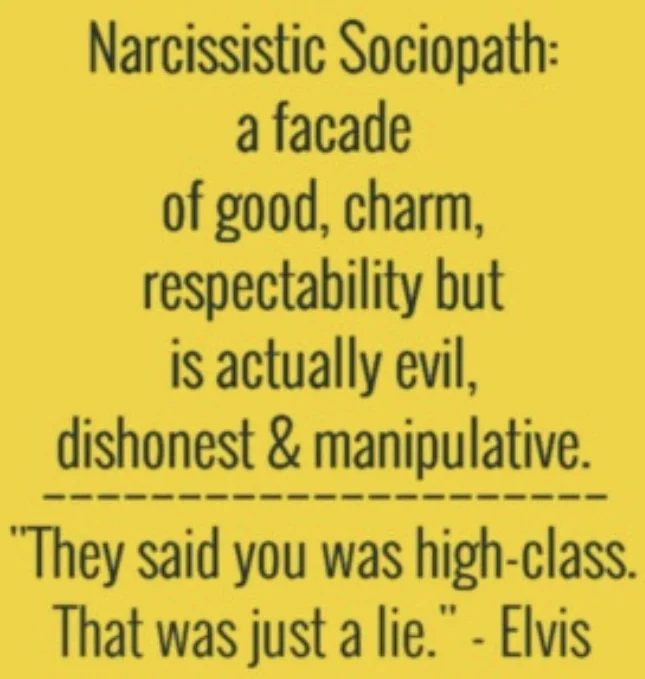
This is very well done P.R. for the devil. I believe music is where the devil most excels.


What is the difference between a borderline and a true narcissist?
By Tom Ewall
Behavior wise they are quite different, but the disorders are very similar, more similar than many think, in my opinion. I realize this may sound confusing, so I'll explain. First similarities.
The cause of both disorders is an attachment disorder due to lack of object constancy. In less technical terms, the young child was neglected/abused/traumatized at a very young age, say around two, and didn't learn that their primary caregiver could be trusted to provide for their needs. They become traumatized, believing their needs won't be met, that they can't express their needs, and that the world is a scary and unsafe place.
They believe their real self has been devalued and rejected (which, tragically, it has been) and that, as they are, they are unlovable and without worth or value. They are filled with shame, because, tragically, they perceive their rejection from the defective caregiver as being their own fault, because there's something wrong with them.
So if they can't get what they need from others by being themselves, they'll create a persona that can get what they need. They learn passive aggressive techniques at an early age, and become masters at manipulating others.
They become emotionally stunted at the age of their trauma, unable to experience more mature emotions, such as gratitude, remorse, empathy, or disinterested love. Shame is absolute anathema, a horror which must be propelled away as far as possible by projection or gaslighting as aggressively and urgently as possible. This explains their inability to apologize, or not be right in regards to their opinions or perceived needs.
They see things in black and white. They are either 100% happy (“I'm good, you're good, everybody loves me, life is good”) or 100% unhappy (“I'm bad, nobody loves me, you suck, life sucks”). There's no in between, calm, balanced state, where things are just normal.
They don't have the ability to perceive others as detached from themselves having separate needs, feelings and desires, and thus they don't care, and cannot care, about others in a mature, disinterested, unselfish way. Victims often confuse themselves thinking that if only the person with the personality disorder could be properly cared for or loved they could improve, but the problem is the reality of people with personality disorders is fundamentally different, and cannot be altered by being loved.
Ok, those are some similarities. There are many more.
Going in to differences. The bpd is extremely needy. The narcissist is extremely confident.
As a simplification, if you take a bpd and move the neediness to extreme confidence, you'll get a narcissist. Hence certain behaviors will be very different. For example, bpds will do things like cut themselves, have panic attacks, have severe depression, and disassociation whereas narcissists will come across as supremely confident, self assured, and competent.
Narcissists are much, much better chameleons. It can be extremely difficult to spot a narcissist. Borderlines are much easier to identify.
In a general sense, one could say the behaviors are similar, as they are driven by the same issues, such as fear of abandonment, as the question correctly identifies. There are other driving factors, such as abhorring shame, needing to be right, to be in control, to have their needs met right now, inability to perceive others as having their own needs, to name a few. However the manner in which these driving factors are dealt with is likely to be quite different, as narcissists are far more confident, and clever in terms of misleading others as to their intent.

How do you know if you met a narcissist? What are the first signs?
By Sarah Bowman
Based on the reading I’ve done, as well as my personal experience, narcissists do not carry warning signs up front. They do their best to fit in, and believe me, they’re good at it. Until you live with the person and encounter them on a day-to-day basis, you may never meet their dark side. The first answer to this question—that they seem like wonderful, amiable people—made me think. It fits the literature and my own experience. That is why I say you won’t notice it up front.
The charm is what draws people in. I would go so far as to say that family members, even children, of a narcissist may not all be aware of the dark side. The narc needs most of the family on his or her side and will manage to keep it so. The kids against the spouse, the spouse and kids against one kid, or any combination.
Those who are treated well are made to think the abuse of the odd one out is the victim’s fault, that somehow the victim is not measuring up quite right and deserves the treatment. In extreme cases, e.g. where a child is imprisoned in a cellar or beaten repeatedly within an inch of life, the others might realize that something is wrong. But talking to people outside the family is strictly forbidden.
So how can you know what you’re walking into? Here are some things that occur to me.
First of all, be wary of the very charming.
Secondly, insist on understanding inconsistencies in their speech, thought, and behaviour. Inconsistencies will appear as you get to know them casually or slightly better. Watch for:
Outright lies
Claims to believe one thing while clearly practising something else, e.g. I don’t believe in being late (person arrived five minutes late last time with no apology or explanation); No one but me drives this car (but you had seen his teenage son driving it a few weeks ago, when you mention it he discounts the incident); If it weren’t for me, the towels in this house would never get changed (no acknowledgement that the last three weeks it was you who changed them). These inconsistencies are weird and they accumulate. Take them seriously unless you are satisfied with the proffered explanations. In my experience, they presage a narc or other nonviolent psychopath of some stripe. Normal people don’t behave like this. I don’t think narcs do it intentionally but they can’t help it.
Accuses you of things you’d never think of doing but it (alarmingly) takes no stretch of the imagination to apply the behaviour to them
DISCLAIMER: These are “red flags” taken from my own life to help me notice people with whom I should not share confidences. I am somewhat unsure about posting them as signs for a narcissist. Credentials: I have some training in counselling but not enough for a certificate or license. You can Google narcissist and read the online literature, like I did.